Here are five indicators, observations or articles that caught the eye of FA futurists today.

Image: Jim68000, Flickr.

  1. New iPhone app in  Iceland ensures that cousins don’t  become “kissing cousins.”
  2. Phillips has developed prototypes of a tubular LED light that could be retrofit into existing overhead fluorescent fixtures. Although the tubular LED bulbs will have a significant cost premium, they offer twice the efficiency of fluorescent bulbs, and generate warm light that is closer to incandescent bulbs.
  3. A writer identifies nine kinds of bad futurism. (We believe that we avoid these traps at Foresight Alliance.)
  4. In the wake of the Boston bombing and manhunt, Richard Fernandez sketches out a possible future of reputation based private security. Access to public events, stores, airplanes, restaurants, and other private spaces could be restricted to verified “club” members, creating a system of segregation through reputation.
  5. The Archangel Ancient Tree Archive is about to begin planting cloned cuttings from some of the world’s oldest redwood trees. The project is two-fold: to rehabilitate redwood forests and to use the (potentially) giant trees as carbon sinks. The new saplings being planted in the U.S., Canada, Australia, New Zealand, Great Britain, Ireland, and Germany, are cloned from some of the oldest redwoods in the world, with the understanding that these trees must have superior genes to have survived this long.


Image: micahb37 (Flickr)

A report last week about the continued decline of the cost of genetic sequencing got me thinking about genetic privacy.

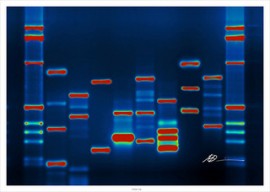
The fabled “$1,000 genome” is coming into view, the pricepoint at which full sequencing can begin to be part of routine medical care in the developed world.

That pricepoint also opens sequencing up for non-medical purposes; someone could do so to find out about a partner, employee, or celebrity, as long as you could obtain some kind of genetic sample.

Celebrities are highly plausible targets; an entire industry seeks out and distributes every little detail about their lives, and genetics promises insight into medical conditions, behavioral quirks, and propensities–all fertile ground for celebrity gossip. Of course, a lot of the information genetics could currently produce will be vague and pseudoscientific, but that hardly matters  for this purpose.

This raises several questions:

  • Is it illegal to have someone else’s genome sequenced?
  • What happens if one has it done in another jurisdiction, as such sequencing will soon be possible in many places with lax enforcement?
  • What are the penalties, given that candid celebrity photos can earn five and six figures?

In the future, I suspect that actress Scarlett Johannson might be more leery of selling a used tissue for only $5,300.


The news that Bing was integrating public Facebook information into its search results was interesting to me on one point: privacy. I know, I know, Facebook and privacy, blah blah blah. (I will avoid discussion about the complexity of FB’s privacy settings, as it has been done to death elsewhere).

Now Mark Zuckerberg of Facebook stated that any information pulled up by Bing would only be that marked by Facebook users to be public. But what tweaked my interest was something that data mining expert Robert Grossman, head of the National Center for Data Mining, told NPR reporter Stacey Vanek Smith: “The likes of friends is one of the most predictive variables of your own likes.” By making public ‘likes’ searchable, Facebook and Bing take a step toward building a consumer profile of you, even if you impose the tightest of restrictions on the sharing of your Facebook data. Whether you like it or not, you are going to become one of the data mined consumer clusters Vanek Smith reported about in her story.

What intrigues me about all of this is how very ‘Red Scare’ it is in execution. You as a consumer are being targeted not only for who you are, but the company you keep. Apologies to my Facebook friends, but while they are all good people, I find a lot of what they ‘like’ to be inane. (But then, I also think the Like button itself is pretty inane. It’s used far too indiscriminately.) Do I want to be tarred with their brush? Or marketed their bad movies or uninteresting books?

Image: Marcopako (Flickr)

© 2012 Foresight Alliance Suffusion WordPress theme by Sayontan Sinha